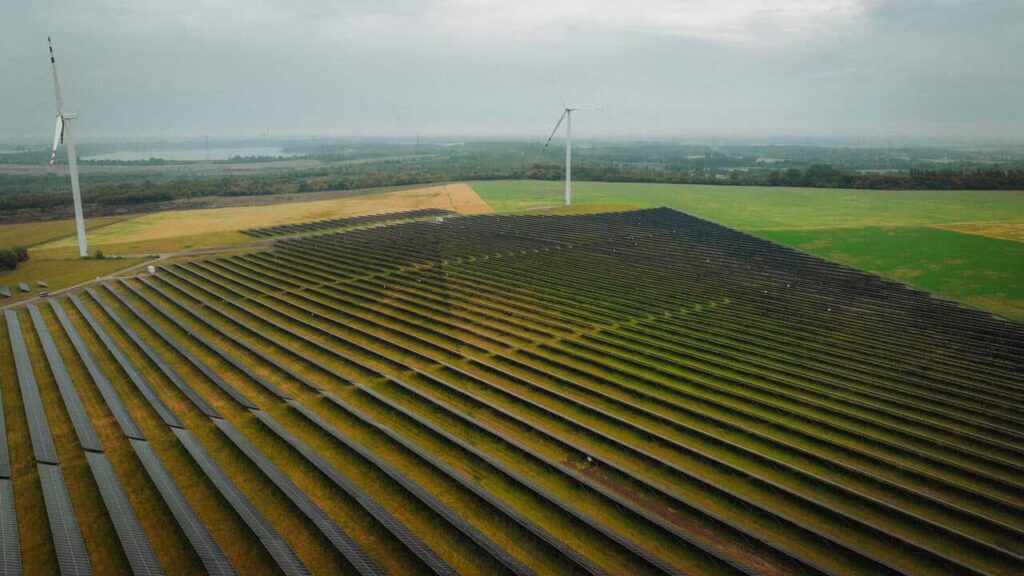
Energy storage is one of the key elements of the energy transition — it enables the full and efficient utilization of the potential of renewable energy sources within the power system.
The generation of energy from renewables, particularly from wind and solar, is variable in nature. This stems directly from its dependence on weather conditions as well as the time of day and season. As a result, the system experiences both periodic energy surpluses and moments of shortage, which complicates grid balancing and the maintenance of stable supply.
This is precisely why energy storage technologies play such a vital role. They make it possible to capture surpluses during periods of high generation and deploy them when demand exceeds current output. Several such solutions are currently being developed and deployed — ranging from lithium-ion battery storage systems to pumped-storage hydropower plants.
In this article, however, we focus on one particularly promising technology that may play an important role in the low-emission future of the energy system. That technology is chemical storage based on green hydrogen.
💊 In brief: green hydrogen, produced through electrolysis powered by renewable energy, enables the conversion of electrical energy into a chemical carrier suitable for long-term storage and further use across various sectors of the economy.
Read: Energy Storage
Read: Green Hydrogen — How Is It Produced?
Hydrogen today — its role in industry and energy
Hydrogen currently plays an important role as a feedstock and reagent, with its consumption heavily concentrated in specific sectors of the economy. The principal areas of use are oil refining (hydrodesulphurisation and hydrocracking processes), chemical production (primarily ammonia and methanol), and metallurgy (as a reducing agent in steel production via the DRI — Direct Reduced Iron — method).
🔗 For more on the areas of hydrogen application, see: Green Hydrogen — How Is It Produced?
As reported by numerous sources, including the Global Hydrogen Review 2024, almost all current production (approximately 99%) relies on fossil fuels (this hydrogen is conventionally referred to as grey hydrogen). This entails significant CO₂ emissions — around 9–10 kg of CO₂ per kilogram of hydrogen produced.
With regard to power systems, hydrogen’s role today remains marginal, accounting for less than 0.2% of global electricity generation (also according to the Global Hydrogen Review 2024); moreover, the energy sector most commonly makes use of mixed gases derived from industrial processes rather than pure hydrogen.
In the future, hydrogen’s role in the energy sector may grow — precisely through its use as an energy storage medium and grid stabilizer within Power-to-Gas technology (discussed further in the section: The Role of Green Hydrogen in Power System Stabilisation — Power-to-Gas).
It will enable the utilization of surplus renewable energy and facilitate large-scale and seasonal energy storage — something unachievable for conventional battery systems mentioned at the outset of this article. From an energy-sector perspective, hydrogen is therefore primarily a future instrument for balancing systems built around solar and wind power.
What accounts for the unique role of green hydrogen as an energy storage medium?
Hydrogen’s unique position stems above all from its fundamentally different nature compared to electricity. Unlike electricity — which is a flow of electrons — hydrogen is a chemical energy carrier based on molecules. This distinction means that in certain applications hydrogen is better suited to meeting the needs of the energy system, though in many others direct electrification remains the more efficient solution.
Chemical energy has played a key role in the economy for decades, enabling stable large-scale storage and transport of energy. Fossil fuels — crude oil, coal, and natural gas — as well as biomass, all function in this form today.
Chemical carriers can be stored for extended periods, transported over long distances including by sea, and used in processes requiring very high temperatures. Importantly, they integrate readily with the existing infrastructure and business models that have developed around fossil fuels.
Hydrogen brings additional flexibility to this system. Its chemical structure allows it to be combined with other elements — such as nitrogen or carbon — to form energy carriers that are easier to store and transport, for example, ammonia or synthetic fuels. At the same time, it can serve as a process feedstock in the chemical and heavy industries, replacing high-emission solutions and making a tangible contribution to the reduction of greenhouse gas emissions.
💡 It is precisely this versatility — the capacity to store energy, serve as a fuel, and function as a process feedstock — that gives green hydrogen its distinctive place in today’s debate on the decarbonization of the economy. It bridges the worlds of energy and industry, offering solutions where electrification alone falls short and opening the way to deep emissions reductions across entire systems.
Read: Electrum to Deliver a 5 MW Electrolyser Project for the Gdańsk Refinery
The Role of Green Hydrogen in Power System Stabilization (Power-to-Gas)
Power-to-Gas (P2G) technology is part of a broader narrative about how to manage energy surpluses in a system built on renewable sources. Its essence lies in converting electrical energy — generated during periods of high wind or solar output — into gaseous energy carriers. In this way, energy that would otherwise be curtailed or lost can be “captured” and used later, when demand rises again.
In practice, Power-to-Gas means primarily the production of green hydrogen through electrolysis powered by surplus electricity. At a subsequent stage, this hydrogen can also be converted into synthetic methane, further expanding the possibilities for its storage and use within existing gas infrastructure. The energy carriers produced in this way have a high energy density and are well suited to long-term storage.
Widely deployed P2G solutions will not only enable the utilization of surplus renewable energy — and, in the future, energy from nuclear power — but will also be capable of connecting what have until now been separate segments of the energy system. This brings us back to the flexibility mentioned a moment ago: integrating the electricity system with the gas system increases the flexibility of the system as a whole and supports its stable operation under conditions of a growing share of renewable sources.
💡 When more green energy enters the grid than is needed at a given moment, rather than curtailing output, that energy can be directed to electrolyzers. The hydrogen produced is stored and then — depending on requirements — channelled to industry, transport, or the energy sector. In this way, hydrogen serves as a long-term and seasonal energy storage medium. This is precisely why, in the future low-emission energy system, renewable technologies, energy storage, transmission infrastructure, and green hydrogen will form an interconnected ecosystem — one in which hydrogen becomes a key element ensuring flexibility and security of supply.
Large-Scale and Long-Term Storage of Green Hydrogen
Unlike lithium-ion batteries, which provide short-term storage (from a few minutes to a few days), hydrogen is suited to medium- and long-term (i.e. seasonal) energy storage — something that will be indispensable in systems dominated by renewables. In practical terms, this means, among other things, that green hydrogen can store summer surpluses of solar energy for use during winter.
As noted in the SES Hydrogen Vademecum, a significant advantage of hydrogen over other energy carriers is the ability to store energy for many months without substantial losses — by converting electricity into hydrogen through electrolysis, then compressing and storing it in appropriate vessels. The stored hydrogen can subsequently be reconverted into electricity — for example using fuel cells — during periods of peak demand, with the overall efficiency of this process depending on the technology employed.
Given that green hydrogen enables energy storage over months or even entire seasons, the question of scale and method of storage becomes critical. Conventional above-ground tanks — while adequate for local and demonstrative applications — quickly encounter cost, space, and safety constraints when the volumes required by a power system are considered.
To fully harness hydrogen’s potential as a large-scale energy storage medium, solutions capable of accommodating very large volumes at relatively low cost and with a high level of safety are essential. In this context, underground hydrogen storage — based on geological formations long used for the storage of natural gas and other energy resources — becomes the natural direction of development.
Underground Hydrogen Storage
Hydrogen can be stored in natural or artificially created geological formations which, by virtue of their scale, are considerably more cost-effective than above-ground tanks. At present, the most mature and widespread technology for underground hydrogen storage (UHS) is that of salt caverns.
These void spaces within rock salt deposits — formed through natural processes or by the controlled leaching of underground salt beds — offer a unique combination of impermeability, geomechanical stability, and the capacity for self-sealing of micro-fractures under pressure.
Underground hydrogen storage is in a phase of intensive development, although practical industrial experience remains limited to a handful of sites. Pure hydrogen has been safely stored in salt caverns at Teesside in the United Kingdom (since 1972) and at Moss Bluff and Clemens in the United States (since the 1980s).
A number of countries are conducting advanced work on UHS. In Germany, for example, the H2STORE project examined the reactivity of minerals in contact with hydrogen, while in Spain the HyUnder project assessed the potential for large-scale storage across Europe.
Poland, encouragingly, possesses favorable geological conditions for underground hydrogen storage — a fact that aligns with the national energy policy objectives of supply security and low-emission transition.
The Oil and Gas Institute, the Polish Geological Institute, and other institutions are examining geological conditions with regard to the stability of future storage sites. In 2024, the State Geological Survey launched a project entitled “The influence of lithological variability within the oldest rock salt formation in the Łeba Elevation area on the geomechanical stability of planned underground hydrogen storage facilities.” The initiative is funded by the National Fund for Environmental Protection and Water Management and is scheduled to run until 30 September 2026.
💡 As reported in the Green Hydrogen from Renewables study, a single cavern with a volume of 200,000 m³ can hold approximately 2,200–2,400 tonnes of hydrogen, equivalent to around 82.5 GWh of energy.
Green Hydrogen as an Energy Storage Medium and a Bridge Between Energy, Industry, and Mobility
Green hydrogen is gradually emerging as a versatile component of the future energy system — a carrier that connects the needs of the energy sector, industry, and transport in those areas where direct electrification proves insufficient.
Its significance is growing particularly in sectors described as hard to abate — those requiring large quantities of energy, high temperatures, or long range and operational flexibility.
By virtue of its physicochemical properties, hydrogen is well suited to heavy and long-distance transport, while simultaneously serving as a zero-emission fuel and process feedstock in the chemical and metallurgical industries.
As a chemical energy carrier, it can also be converted into other forms — such as ammonia or synthetic fuels — which facilitates its storage and transport and opens the way to international trade in clean energy.
In this manner, hydrogen will not only increasingly support the decarbonization of individual sectors, but will also bind them together into a single, more flexible and resilient system — one in which the capacity for large-scale and long-term energy storage will play a central role.