Studying energy engineering is a sound investment in the future. Energy underpins the functioning of the modern world, and the growing demand for electricity, heat, and innovative technologies related to energy efficiency means that graduates of this field have broad professional prospects ahead of them. At Electrum, we employ many specialists in this area and regularly expand our team, seeking candidates who are open to development and possess extensive knowledge of renewable energy sources.
In today’s article, we will look at the various career paths centered around energy engineering.
What does studying energy engineering involve?
When planning to study energy engineering, one should be prepared for a strong emphasis on the exact sciences. The curriculum includes subjects such as mathematics, physics, chemistry, engineering mechanics, design, and automation. Students gain knowledge of thermodynamics principles, the operation of electrical machines, energy management, heat and mass transfer, and environmental protection. They examine the influence of individual processes and their parameters on energy efficiency, plan energy distribution, and learn about solutions enabling electricity generation in the most sustainable way possible.
Energy engineering studies are primarily practical in nature – they involve numerous laboratory sessions and technical projects. As part of their professional preparation, students work with heating and cooling systems, energy process simulators, and thermodynamic testing equipment. Placements at power plants, combined heat and power plants, energy companies, and installation firms are standard. All of these elements play an important role in adequately preparing students for the conditions of a real working environment.
What employment opportunities are available to energy engineering graduates?
Energy engineering graduates have a very wide range of employment options:
- Power plants and combined heat and power plants – part of the sector responsible for generating electricity and heat; work primarily involves supervising processes, maintaining operations, and optimizing production.
- Renewable energy (RES) – the dynamically growing market of wind farms, photovoltaic installations, biogas plants, and energy storage; those employed in this area may be involved in the design or construction of installations, as well as participating in research on clean technologies.
- Energy companies – grid operators and energy firms involved in the transmission, distribution, and sale of energy; work relates to network management, energy quality analysis, and the implementation of smart grid technologies.
- Industry – manufacturing plants require specialists for energy consumption optimization, the implementation of efficiency measures, and supervision of technical installations.
- Public administration – state bodies analyze energy policy, prepare audits, reports, and energy transition plans.
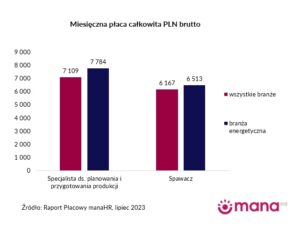
Work in each of these areas differs both in terms of scope of responsibilities and salary level. It is worth noting, however, that compared to other industries, monthly earnings in the energy sector are very competitive. Below is a sample comparison drawn from the manaHR 2023 Salary Report, showing a comparison of gross monthly salaries for selected energy sector roles versus other industries. Both production planning specialists and welders earn higher average wages when working within the energy sector – an important consideration for those interested in energy engineering who are uncertain whether it is a worthwhile career path.
Read also: Working in Photovoltaics – What Are the Popular Career Paths?
The most popular positions in the energy sector
The most sought-after positions in the energy sector include:
- Energy engineer – responsible for the design, analysis, and supervision of energy installations and systems.
- Renewable energy specialist – involved in the design, installation, and performance analysis of photovoltaic, wind, and other renewable energy systems.
- HVAC/electrical/PV installation designer – produces technical documentation and installation designs.
- Energy analyst – develops forecasts, models, and analyses relating to energy production, consumption, and costs.
- Power plant / CHP plant operator – monitors energy generation processes, operates equipment, and ensures installation safety.
- Energy consultant – advises companies and public bodies on energy planning, modernization, and investment.
At Electrum, we also employ renewable energy specialists and regularly grow our team in line with the ever-increasing number of projects we undertake. We recruit for positions such as RES facility monitoring and supervision engineer, PV and wind farm service engineer, BESS designer, and automation engineer.
Conventional energy – is it worth considering?
Although the future of energy is increasingly discussed in the context of renewable sources, coal, gas, and nuclear power plants continue to operate, accounting for a significant share of electricity production. Energy engineering graduates can find employment in these facilities, working in areas such as installation operation, supervision of technological processes, and modernization of existing infrastructure.
It is important to be aware, however, that in the longer term the conventional sector may diminish in significance – both in Poland and globally – as demand for environmentally friendly technologies continues to grow. Working in conventional energy therefore offers stability in the here and now, but it is innovations based on renewable energy sources that open up more development prospects for the future.
Can an energy engineering graduate find work in renewables?
Renewable energy sources currently represent one of the most dynamically developing sectors – the foundation of the energy transition unfolding before our eyes. It is therefore well worth exploring this field when seeking employment after an energy engineering degree.
An energy engineering graduate can work on the design of wind or photovoltaic farms, conduct investment feasibility analyses and provide advisory services to companies or municipalities seeking energy independence, or work in the operation and maintenance of existing systems. The development of renewables, however, extends well beyond panels and turbines – energy storage projects, next-generation batteries, and hydrogen technologies also play an important role.
Career opportunities in renewables can be grouped into several main areas:
- Construction and operation of installations – photovoltaic farms, wind power plants, and biogas plants.
- Innovative technologies – green hydrogen and energy storage.
- Digitalization and grid integration – development of smart grids and energy management systems.
- Advisory and analysis – energy audits, local system transition planning, and cost optimisation.
We also employ specialists in these areas at Electrum, as we seek to grow in a market encompassing both large-scale RES projects and advanced automated technologies.
It is also worth mentioning that working in renewable energy means not only broad career development opportunities, but also acting in accordance with values relating to environmental protection and responsibility towards future generations. You can read about other benefits of choosing this career path in our article: RES Careers: Why It’s Worth It and How to Get Started? – Electrum.
Careers in energy engineering – project management
Project management of large, complex investment ventures – both private and public – is playing an increasingly important role in the energy sector. An energy engineering graduate may aspire to positions such as project manager for power plant construction, transmission grid modernization, or the implementation of energy efficiency solutions in companies. In this career path, the ability to combine technical knowledge with managerial competencies is essential. Effective planning, cost control, team management, and familiarity with energy market regulations are all highly valued.
Can an energy engineering graduate work in a laboratory?
Yes, and in many different ways. Graduates with a research orientation can find employment at scientific institutes, industrial laboratories, and research and development departments of technology companies.
This work often involves searching for new solutions that may in the future transform the energy market – researching new energy storage materials, developing next-generation photovoltaic technologies, or testing hydrogen applications. Laboratories are an environment for those who enjoy experimenting, analyzing results, and continually expanding their knowledge.
What skills are essential for energy engineers?
Working as an energy engineer requires a combination of technical knowledge, analytical skills, and interpersonal competencies. A sound understanding of power systems – their structure, operating principles, protection systems, network operation, and supply stability – is important, as is familiarity with SCADA systems used for monitoring and controlling energy processes (see: SCADA: The Heart of Modern Farm Monitoring | Electrum). The skill set of an energy engineer also includes proficiency with CAD tools for installation design, as well as a solid grounding in the standards and regulations governing energy infrastructure.
Soft skills should not be overlooked, however – they are what determine the quality of work with people. Good communication is essential for effective project management, i.e. the coordination and supervision of energy investments involving multiple teams and subcontractors.
What are the current trends and demands in the energy sector?
When planning to study energy engineering, it is worth understanding the direction in which the entire sector is currently heading – because it is undergoing a complete transformation. Growing energy demand, the development of renewable sources, and the digitalization of energy infrastructure are causing the market to change rapidly, requiring new competencies and technologies.
The primary driver of change is, as noted, renewable energy. Solar and wind power are becoming the foundation of new generating capacity worldwide. This trend is driven by climate targets, the increasing cost-competitiveness of installations, and the need for energy independence. An ever-growing number of PV farms, hybrid projects, and distributed energy sources are emerging – generating demand for specialists in renewables, automation, and the integration of new sources into the grid.
It is worth noting the IEA Renewables 2025 report, which records a significant increase in renewable energy generating capacity between 2023 and 2025, covering photovoltaic and wind systems as well as hydropower and bioenergy. Photovoltaics achieved the highest output in 2025 – a fact worth bearing in mind when seeking employment in renewables. The report also shows that the sector will continue to grow, meaning we can expect rising demand for renewable energy specialists.
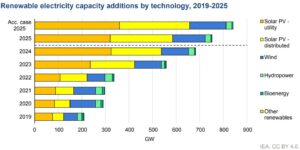
Source: IEA, Renewables 2025
Further significant trends include:
- Grid modernization and energy storage - construction of smart grids and investment in energy storage facilities.
- Digitalization using artificial intelligence - from SCADA systems and data analysis to the use of AI for installation optimization.
- Green hydrogen - produced using renewable energy, it represents a low-emission fuel of the future, particularly important for sectors that are hard to electrify, such as heavy industry and long-distance transport.
- Energy security - geopolitical challenges and the need to reduce dependence on imported fuels are driving countries and companies to invest in local sources, flexible capacity, and transmission infrastructure.
At Electrum, we are aware of the changes ahead. We actively support the energy transition by delivering RES and energy storage projects, conducting research into advanced management systems, and working on hydrogen technologies. Collaboration with people who share these values is important to us – the shared pursuit of a zero-emission future is a central goal in building our team.
What regulatory changes are affecting the energy sector job market?
In recent years, regulations across Europe and globally have been evolving rapidly to support the energy transition. The European Green Deal, new directives, and national strategies implementing EU targets are setting the direction of the transformation, accelerating the development of renewables, and driving the modernization of the power system. They introduce higher RES targets, more stringent climate requirements, and new technical and operational standards. For the energy sector, this means the need for rapid adaptation, infrastructure modernization, and investment in new technologies – particularly renewables, hydrogen, and energy storage.
Why is it worth studying energy engineering?
Energy engineering provides comprehensive preparation – combining technical knowledge with economic analysis and elements of law. As a result, graduates are not confined to a single path but can choose from a wide range of areas. The most frequently cited advantages are:
- Diversity of employment options - from energy companies and public administration to research and consultancy.
- Stability stemming from the constant demand for energy and for specialists in this field.
The broad career opportunities available after an energy engineering degree provide both professional security and the chance to develop within modern, innovative projects.
How to develop your career in energy engineering?
After completing an energy engineering degree, there are many ways to develop your career. To continue growing in the sector, it is worth investing in specialist training and courses – for example in renewable energy, project management, or cybersecurity. Specialist certifications also play an important role: CEP certificates (confirming qualifications for work involving electricity and heat), as well as certificates from various training courses (for PV installers, CAD design and operation, and automation and control systems). Obtaining these early in one’s career opens the door to a wide range of technical and design opportunities. Regular upskilling also allows for faster adaptation to market changes and increases attractiveness to employers.
It is important to remember, however, that in energy engineering – as in other industries – networking matters greatly. It is therefore worth attending trade fairs, conferences, and sector events, joining thematic groups on LinkedIn, and maintaining good relationships with lecturers and fellow graduates.
Careers in energy engineering – summary
Energy engineering is a sector that builds on proven solutions while embracing new technologies. On one side there is a stable, though gradually evolving, conventional sector; on the other, the dynamically growing renewable energy industry. A graduate of this field can find their place as an engineer, a project manager, or a researcher working on innovations.
It is a profession of the future – not only because careers in energy engineering offer strong financial prospects, but also because they allow you to co-create the solutions that will shape the world in the decades to come.
Those interested in working in renewable energy are welcome to explore the current vacancies at Electrum. We provide our employees with broad development opportunities, supported by experienced specialists. It is also worth noting that we have been recognized by the weekly magazine Wprost as one of the 50 best employers in Poland. Working with us means the opportunity to participate in the delivery of large-scale RES facilities, work on innovative technologies, and help build a better, greener future for generations to come.
Explore current employment opportunities at Electrum: Find a Job – Electrum