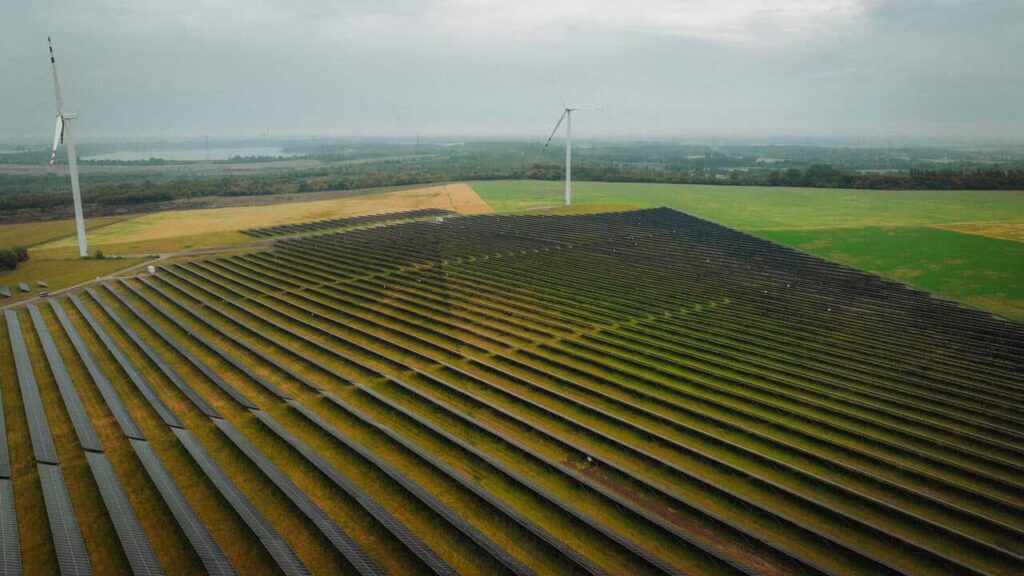
Recent years have brought a genuine breakthrough in Polish energy. For the first time in history, the share of renewable energy sources in Poland’s installed capacity has exceeded 50% – a result that, just a decade ago, might have seemed a distant vision of the future.
The changes that took place between 2020 and 2025 demonstrate clearly that green energy has ceased to be a niche supplement to the national energy system and has become its foundation. Photovoltaics, wind farms, and increasingly energy storage too – these are the technologies that are reshaping Poland’s power grid before our eyes.
Record-breaking figures, however, are only half the story. The dynamic growth of installed RES capacity raises a question the industry is asking ever more loudly: is the transmission and distribution infrastructure keeping pace with this rate of change? Is Poland’s power grid ready for what is already happening – and for what is yet to come?
The energy transition and the modernization of the power grid
The dynamic development of renewables presents grid operators with a challenge that cannot be resolved by conventional methods alone. The current grid architecture was designed with a centralized generation system in mind – not thousands of distributed, weather-dependent sources whose output changes from hour to hour.
Modernization and expansion of infrastructure are of course essential, but they are not sufficient in themselves. They involve high costs and long implementation periods, and the pace of the energy transition does not allow for delays. It is therefore necessary, in parallel, to deploy solutions that increase grid flexibility – that is, the ability of generation, storage, consumption, and grid assets to dynamically adapt to current, variable conditions.
The greatest barriers to RES development stem from the state of the grid
The distribution networks – to which more than 90% of new RES capacity is connected – are undoubtedly the bottleneck of Poland’s energy transition. The situation is further complicated by the sharply rising number of connection applications year on year: in 2023, PSE processed 347 such applications, whereas in 2024 the figure rose to 783 new applications and 469 supplementary ones.
Problems with overloading, capacity constraints, and the availability of connection capacity are becoming a reality, with a direct impact on a significant number of connection refusals on grounds of grid limitations. Reports from the Energy Regulatory Office (URE) indicate that the refusal rate reaches as much as several dozen percent of the capacity submitted in applications, and is set to remain at a very high level.
Existing mechanisms – such as DSR, cable pooling, and flexible connection agreements – can and certainly will increase the utilization of existing infrastructure. However, without the introduction of coordinated, system-wide changes aimed primarily at increasing grid flexibility, we may ultimately face the risk of slowing not only the energy transition, but also the decarbonization of other sectors of the economy.
Investment in power grid modernisation in Poland
Aware of the challenges ahead, the Energy Regulatory Office approved, at the end of 2024, the 10-year transmission grid development plan proposed by PSE. The implementation of this plan is intended to enable, among other things, a significant increase in the potential for building new RES sources – including the connection of approximately 18 GW of offshore wind farms, around 45 GW of photovoltaic sources, and over 19 GW of onshore wind farms – as well as the connection of a nuclear power plant in Pomerania and other smaller nuclear reactors. The plan envisages that by 2034, 4,700 km of new 400 kV line routes will have been built, 28 new substations constructed, and 110 existing ones modernised.
Also worthy of note is one of the plan’s most important projects: the construction of a high-voltage direct current (HVDC) interconnection. This will link the north of the country with the south, enabling the transmission of power from new generation sources to consumers without placing additional load on the rest of the transmission grid.
Flexibility – the key to a stable transition
As the share of renewables in the power system grows, energy production becomes increasingly dependent on weather conditions, bringing with it greater variability and more challenging system forecasting.
In such circumstances, technologies that increase system flexibility and enable rapid response to energy surpluses or shortfalls become enormously valuable. Flexibility services can be provided by both generation and storage assets. It is logical, however, that the greatest potential lies in large-scale investments such as utility-scale energy storage, power plants, combined heat and power plants, and flexibility-oriented industry.
How can technology unlock the growth of renewables?
To increase the flexibility potential of the entire power system, it is essential to deploy smart grid technologies – those that enable the monitoring, coordination, and control of assets.
At Electrum Group, we recognize the importance of increasing grid flexibility, which is why our service offering includes, among other things:
- The design and implementation of smart power grids, including virtual power plants (VPPs), encompassing the integrated management of distributed energy sources, storage systems, and consumers within a single digital control system. Through the use of algorithms, automation, and data analytics, VPPs enable power balancing, installation optimization, and increased grid flexibility.
- The construction and modernization of power substations with real-time control, protection, and monitoring systems.
- Energy management systems enabling dynamic grid management, consumption optimization, power balancing, and energy storage integration.
- The integration of energy storage systems and the design of hybrid energy configurations supporting grid stability and efficiency – enabling energy to be accumulated during periods of overproduction and deployed during periods of increased demand, reducing wholesale price volatility and improving the financial viability of RES investments. This makes battery energy storage systems one of the most important components of the future power system.
- Advanced metering systems enabling precise monitoring of grid and consumer parameters.
- Grid automation systems enabling rapid fault detection and isolation, and the reduction of supply interruption durations.
- Advisory and analytical services in the areas of energy transition, infrastructure digitalization, and the deployment of advanced grid technologies.
Summary
As the difficulties accompanying the rapid growth of renewables in Poland in recent years have demonstrated, the country’s power grid is, regrettably, not yet ready for a genuine energy transition – one that goes beyond the simple replacement of emitting sources with renewable ones, and whose true effectiveness is measured by, among other things, the capacity for flexible management of energy production, demand and supply, the ability to store energy, and the efficient transmission of power between regions.
It is worth remembering that how we navigate this transition will determine not only the stability and resilience of the grid, but also the continued development of the economy as a whole.